Total Pageviews

Showing posts with label Movies: Top Film Reviews. Show all posts

Monday, June 6, 2016

Popstar: Never Stop Never Stopping (6-3-2016)

        When it comes to comedy, there's an awfully thin line between clever and stupid. Many prefer to maintain a sort of binary between the two, slotting their Woody Allens in one file, and their Adam Sandlers in another, and while the two aforementioned examples would certainly support that level of genre organization, many of our best laugh-fests locate something of a sweet spot in between. Describing Dumb and Dumber as an intellectual feat would raise eyebrows in any room in which the claim was uttered, but there's a brilliance to the film's steadfast devotion to exploring the deepest depths of idiocy. Same goes for Anchorman, This is Spinal Tap, Airplane!, or any other movie so brazenly moronic that it simply must have been made by a genius. Flicks baring this lofty level of inspired lunacy are few and far between, so let's take a moment to observe the accomplishment of The Lonely Island (among our generation's most heady dunces), and their pitch-perfect film debut, Popstar: Never Stop Never Stopping.

        Comprised of SNL alums Andy Samberg, Jorma Taccone, and Akiva Schaffer, the three-piece mock-rap outfit has been making side-splitting bangers since 2009, graduating from an NBC sideshow into semi-legitimate band with three albums to their name. Though their lyrics constantly vacillate between comic shrewdness and goading randomness, the group's production values have always remained strikingly on par with the popular music of the moment. Popstar pulls off a similar trick, relaying a story of relentless absurdity with the conventions and trappings of a legitimate Concert Documentary. Given the movie's easy classification as a Mockumentary (they still make those?), it's almost impossible not to compare it to the aforementioned Spinal Tap. That film found its humor in observing the death knell of the gloriously gaudy rock of the late 70's and early 80's; this one lambasts the cliches of modern stardom, and does so with an acute awareness of its many influencing factors, from social media to technological advances to our fascination with knowing the political stances of famous individuals whom we will never meet. Music movies, wether they be documentaries, narrative features, or concert films, have a tendency to look backwards, making the of-the-moment freshness of Popstar stand out from the pack, and affording it a whole new set of targets at which to take aim.

        Though we know them in real life as The Lonely Island, the new movie rebrands the trio as The Style Boyz, a Beastie Boys-type outfit who made their name on crass lyrics, and pop hits absurd enough to remind us that, as a collective society, allowed Who Let the Dogs Out? and The Macarena to become global phenomenons. The least overtly talented but somehow most charismatic member Conner (Samberg) ends up going solo under the moniker Conner4Real, and while his initial monetary success is measured in millions, Popstar prefers to observe his failures, and subsequent unraveling. He's joined on tour by a hoard of clingers-on, including a publicist (Sarah Silverman), a manager (Tim Meadows), and former bandmate-turned-DJ Owen (Taccone). What ever happened to the original band's third member, you ask? Well, he's taken up a reserved life as a farmer on a particularly isolated plot of land in Colorado, from where he just about steals the whole movie.

        He also directs it, along with Taccone, and their collective prowess behind the camera is not to be ignored. The movie at large plays like a series of 3-minute-long sketches, but the filmmaking tandem shows an unteachable understanding of when one joke is played out, and it's time to move on to the next. Clocking in at 86 minutes in total, I'm not sure Popstar could stand to be even five minutes longer, but entirely too much would be lost were it five minutes shorter. Despite the movie's utter madness, there's a heartening level of control on display in all levels of production, especially in the editing room. Today marks the fourth day of the film's existence on the big screen, and after its opening weekend struggled to make it past 4.5 million dollars, you'd be wise to anticipate its theatrical existence to only live on for another ten days are so. Given the financial history of this type of film, it's a fairly easy deduction that both music movies and Mockumentaries are not genres that prompt excitement in most people. I suppose I'm just a sucker for funny songs, and if this movie doesn't sound appealing to you on paper, I won't try to force my praise of it upon you. But I will say this; Popstar: Never Stop Never Stopping accomplishes virtually everything it sets out to do, and if this premise is at all in your wheel house, I implore you to see it, and on the big screen, where the musical numbers manage to legitimately impress. That line between clever and stupid has never been so blurry, nor has the divide between sloppy mania and attentive perfectionism.

Grade: A-

Monday, May 23, 2016

The Nice Guys (Release Date: 5-20-2016)

        Hi, I'm Collin Sherwood Elwyn, and I'm here to talk to you about a lofty social issue that you've undoubtably been pondering of late; what movies should I pay to actually see in theaters? With streaming services beaming so much media directly into our homes, it's becoming harder and harder for the average person to get up, drive to their local theater, and fork out $12 in order to watch a movie that will be right at their doorstep if they just wait a couple months. There is, however, a remaining sentiment that some movies, wether they star superheroes, dinosaurs, or Vin Diesel, must be seen on the big screen. Hollywood is well aware of this, and over the last decade or so has drastically reduced the production of 'middle ground' movies, aka anything with a budget under 150 million dollars, or without a chance at winning an Oscar. Many have complained about the supposed death of the 'adult movie,' but their disappearance has everything to do with people's growing desire to enjoy their films while parked on the couch. With every dollar we spend at the box office, we cast a vote for big wig executives to make more of that type of movie, which brings me to my plea. Please, if you have any interest at all, vote for The Nice Guys.

        Set in the scuzzy, neon-tinged underbelly of late 70's Los Angeles, the film follows two men who do just about everything in their power to negate the movie's title. We first meet Jackson Healy (Russell Crowe), a particularly heavy heavy who, by his own description, beats people up for money. One such business transaction brings him to the home of Holland March (Ryan Gosling), a low-rent Private Eye who's decidedly more adept at cashing his checks than finding his marks. The meeting goes poorly (for Holland anyway), but a series of circumstances find the unlikely pair working together to find a missing porn star who may or may not already be dead. Cue the rapid-fire wise-cracks, gloriously tacky costumes, and rollicking retro soundtrack.

        Only three feature films into his directorial career, Shane Black's stamp of authorship is about as bold as anyone working in movies today. Having made a name for himself by penning the Lethal Weapon series, Black has doggedly remained in his own hyper-specific wheelhouse, even highjacking the Marvel machine for over two hours and morphing Iron Man 3 into yet another smart-alecky buddy cop flick. The one true modulation this one makes to the formula is in its historical setting, and since the 70's has become our generation's default era for the Noir genre, all of that grooviness fits Black like a glove. The zippy camera movements and exhilaratingly hard cuts that have always been featured in his work feel more at home than ever before, and pair seamlessly with the movie's impeccable costume and set design.

        He's also a great director of actors, and The Nice Guys extends his streak of wedging two terrific performances into one movie without ever clogging up the system. Crowe needed this role more than perhaps any active American actor, having squandered much of his good will over the last few years by only accepting the most serious parts imaginable. One wouldn't exactly call him light-hearted here either, but the vibe of the movie and the performances that surround him turn the Oscar winner into an ideal straight man. Gosling couldn't be more crooked if he tried, and while the movie affords him the lion's share of the funniest moments, what he does with the opportunity is astounding. The way he rattles through Black's dialogue is to be admired, but the bigger take away is just how gifted Gosling is as a physical comedian, his innumerable ticks and mannerisms worth the price of admission on their own. Many have already compared his Holland March to a Buster Keaton character, but I'll go less lofty with my comparison, and simply claim that this is the most laughter a hollywood superstar has coaxed with only their movements since Leonardo DiCaprio made that ill-fated crawl across the parking lot in The Wolf of Wall Street. Truth be told, I can't come up with anything negative to say about The Nice Guys; it's engaging, humorous, stylish, and, most importantly, is the most pure, undiluted fun I've had at the flicks in well over a year. This election year, I'll be voting for Shane Black.

Grade: A

Monday, May 9, 2016

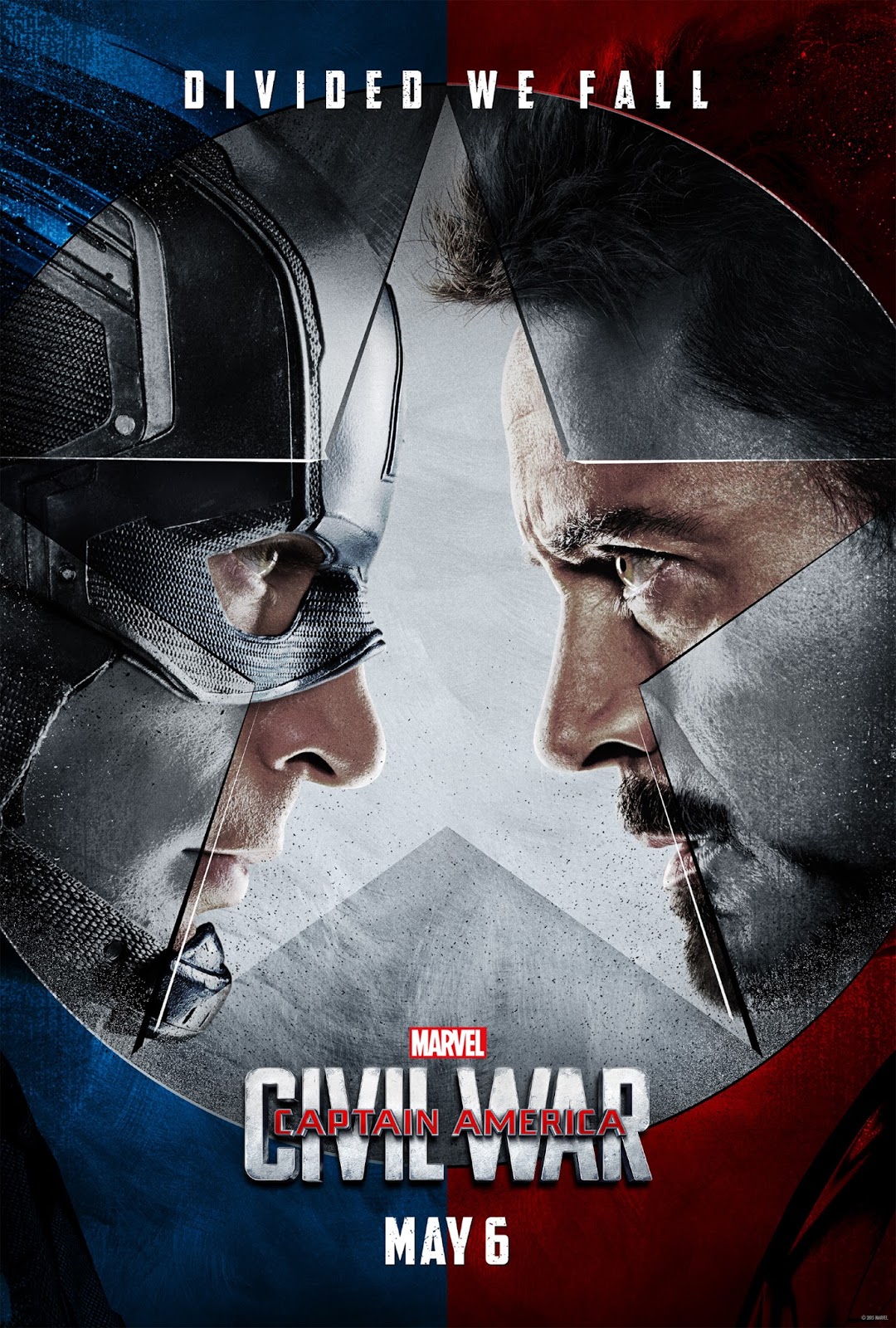
Captain America: Civil War (Release Date: 5-6-2016)

        Marvel Studios has always been fairly brilliant in a variety of ways, but 2016 will go down as the year they started gaining real self-awareness. Like the smart-ass A.I. featured in last summer's Avengers: Age of Ultron, figurehead Kevin Feige and his merry band of comic book adapters have assessed the reactions of movie goers to Marvel's not-at-all-pretentiously-titled Phase One and Phase Two, and apparently have no problem with a touch of late-game revisionism. It's an open secret that this film-making collective has a real problem creating compelling villains, and I'm hardly the first to whine about their insistence on including a glowing McGuffin for our heros to wage war over. There's also the unwieldy problem of the individualized movies, wherein singular heros are faced with seemingly insurmountable odds, and yet fail to remember to phone numbers of either Bruce Banner or the Stark residence. Captain America: Civil War is both specific and exacting in its refutation of these complaints, and yet still wears the Marvel mission statement proudly across its chest for all to see.

        It also has no problem stealing Batman v Superman: Dawn of Justice's lunch money, and then giving it a swirly for good measure. In a plot you might recognize from Zack Snyder's ill-fated battle royal that hit screens less than a month and a half ago, earth has grown anxious over the presence of her mightiest heros. After the series of catastrophic throw-downs we've witnessed in subsequent films, the United Nations have banded together, and landed on a solution: all superheros must register as such, and may only be deployed when the UN collectively sees fit. Tony Stark/Iron Man (Robert Downey Jr.) sees the logic immediately, having been haunted by the demons of his past for several movies now, and implores everyone to sign the paper work. Steve Rogers/Captain America (Chris Evans) could hardly be more opposed, citing an indestructible impulse to save people whenever danger becomes imminent. Their disagreement tears the Avengers apart, rendering the presence of a super-villain irrelevant. The true culprit here is bureaucracy.

        Which isn't to say that Marvel has lost their signature brand of light-hearted fun. Much of what makes Civil War such an out-and-out success is the way it balances heated political discussions with scenes where Scarlett Johansson throws motorcycles at people, and proceeds to do violent gymnastics with giddy exuberance and joyously unrealistic aplomb. As was the case with their Marvel debut Captain America: The Winter Soldier, directors Anthony and Joe Russo imbue the universe with a seriousness that other directors have strayed away from without ever losing track of what makes these flicks such fun, comforting watches. In many ways, the movie plays like a two-and-a-half hour mea culpa for the aforementioned Ultron, a film that promised to bring dire stakes to a universe that had no idea how to deal with them. Describing this as a Captain America movie is straight-up disingenuous: Civil War crams as many of your favorite crime fighters as will fit into its extended runtime, and somehow even the moments that feel utterly shoehorned manage to register.

        Those wondering how a single film could possibly wrangle all of our previously established characters into one narrative while managing to introduce even more are not wrong in their skepticism. On a purely factual level, there are too many players on hand to do all of them justice, and the studio's much-ballyhooed introduction of Spider-Man (Tom Holland) is a branding exercise of the purest sort. It's also really damn fun, forming a dichotomy that could easily be used to describe the film at large; not everything here is exactly cohesive, but it's all a blast to watch. The Avengers is certainly the more 'perfect' of the two films, largely because of its sure-minded decision to prioritize characters over anything resembling a juicy plot, but Civil War manages to spin a yarn about 7,349 different superheros that, more or less, makes sense and is consistently engaging. For the first time since The Winter Soldier, banter isn't the defining feature of a Marvel film. My favorite remains Guardians of the Galaxy, which is a roundabout way of saying I have no qualms with these movies' sense of humor. It's just striking and refreshing to see it moved lower down on the totem pole of priority.

        Much has been made of the 6-on-6 battle alluded to in the trailer, but the Russo's deserve credit for their action chops throughout the rest of the feature as well. Often playing out like Jason Bourne for 9-year-olds, the action is kinetic, sweaty, and captured with a jittery urgency. The spacial reasoning is occasionally lacking, but it's still a blast to see these demigods participate in combat that actually has some weight to it. Black Panther in particular, expertly played by series-newcomer Chadwick Boseman, is a blast to watch on the battle field, and is even afforded a proper character arc by the film's bloated runtime. The movie feels even longer than its stated two-and-a-half-hours, and while my engagement was consistent enough to forgive the excess, scenes where Scarlet Witch (Elizabeth Olsen) teaches The Vision (Paul Bettany) how best to prepare food and speak with cinema's worst Russian accent are probably a bit overkill. But who's counting? Capatin America: Civil War is a near-perfect Marvel experience; almost all your friends are here, they all receive ample screen time, and there are finally actual stakes involved, even if they're mostly just emotional. The studio has crossed their t's, dotted their I's, and made one of their very best movies to date.

Grade: B+

Tuesday, March 15, 2016

10 Cloverfield Lane (Release Date: 3-11-2016)

        When Cloverfield arrived at the beginning of 2008, opinions were divided to say the least. While the revolutionary viral campaign led it to what was then the biggest January opening of all time, many filmgoers reacted negatively to the movie's hand-held camera work, and ultimately open-ended nature. I personally adore the film, but I had no idea there was such a cult surrounding it, the flick's quasi-sequel 10 Cloverfield Lane drawing in just under $25 million in its first three days of existence. It's no secret that modern audiences are all about supporting interlocking franchises, with Marvel Studios still riding high, and this month's Batman vs. Superman staring down tremendous box office returns just for alluding to an expanded universe, rather than having already constructed one. The new Cloverfield undoubtably received a boost from its association to the previous feature, which is a bummer of sorts. Not only have hoards of audience members already emerged frustrated with the tenuous connection between the two movies, but the latter is the rare modern tentpole entertainment that's completely capable of standing on its own two feet.

         Mary Elizabeth Winstead stars as Michelle, a young woman who we meet in a nearly wordless opening as she frantically grabs her things, and appears to flee her own apartment. Her flight is interrupted by Howard (John Goodman), a mysterious man who either abducts or saves Michelle depending on which character you ask, storing her in the deep recesses of his underground bunker. The shelter's only other inhabitant is Emmett (John Gallagher Jr.), a small-town dunce who agrees with Howard that above the surface is the last place anyone would want to be, suggesting that some sort of doomsday might be afoot. As the three attempt to wait out an unseen apocalypse, Michelle's ever-roving eyes pick up one clue after another, tirelessly searching for more concrete information, or a big enough opening to make a break for it.

        10 Cloverfield Lane marks the feature directorial debut of Dan Trachtenberg, and based on this evidence, we should probably get used to hearing his name. From first frame to last, the 34-year-old imbues his film with a remarkable sense of urgency; where other pictures of this persuasion prefer to dangle carrots on the screen to ensure that the audience is nice and hungry by the closing passages, Lane gobbles up every delicious treat it finds before moving directly onto the next, creating a constant flurry of excitement through rule-breaking and discovery. Trachtenberg's team is his match every step of the way, from Bear McCreary's ever-percolating electronica score, to Jeff Cutter's curious, caffeinated camera work, and Stefan Grube's masterclass in the editor's room, which is sharp enough to cut diamonds. The film wears its PG-13 rating proudly, largely avoiding the gore, torture, and rampant violence that one would almost naturally expect from this type of story, but don't think for one second this diminishes its omnipresent intensity. Your heart will still be pounding long after the credits roll.

        While each and every facet of what's going on behind the camera is of rarified quality, it's the thespians in front of it who will undoubtably take the lion's share of the credit. Gallagher Jr. is charming and natural in a largely thankless roll, but his character is forced to the backseat by the pair of electric performances at the flick's center. Now 63-years-old and a veteran of the film industry for over three decades, John Goodman delivers some of the best work of his career, always dancing the impossibly thin line between mania and clarity. As expertly written as Howard is, the film wouldn't work without Goodman's intimidating physical presence, and a myriad of expressions that undulate from passive to downright hysterical. The guy's a national treasure, and while we should count ourselves blessed to see him in such a juicy role so late into his career, Winstead is only just getting started. Best known as the object of Michael Cera's affection in Scott Pilgrim vs. the World, the up-and-comer is finally allowed to spread her wings in a part that would remind us all of the resourceful badassery of Ellen Ripley had Star Wars: The Force Awakens not so recently repurposed that character in the form of Daisy Ridley's Rey. Quick to think and even quicker to act, Winstead possesses the rare ability to convey tremendous intelligence with nothing more than a simple glance.

        Her brains and ingenuity keep us invested even as the story neglects to provide her with much backstory. Same goes for Howard, who will undoubtably be seen as a lunatic by certain viewers, but whose sharp scientific mind and knack for reading people make him less of a monster, and more of an ideal foil. Most thriller/horror movies like this struggle to present us with a single competent character, but this one has two, creating a wonderfully imaginative game of cat-and-mouse wherein you're never quite certain who owns the upper hand. No, 10 Cloverfield Lane will not be a Best Picture nominee at next year's Oscars, and it's also not the type of film folks rush out and implore you to see. The stakes aren't high enough, the stars aren't big enough, and it lacks an entire back catalogue of lead-up films that tend to power the broadest type of audience excitement. It's a shame, because Trachtenberg's film is roughly 187-times more engaging and fun than almost all the flicks I just described, and it doesn't need the world to topple over to keep your hands balled into fists. The creative team behind the film certainly doesn't hurt, but at the end of the day, what 10 Cloverfield Lane most effectively reminds us is this; some times the only thing you need to tell a damn good story is to have a damn good story to tell.

Grade: A

Friday, February 12, 2016

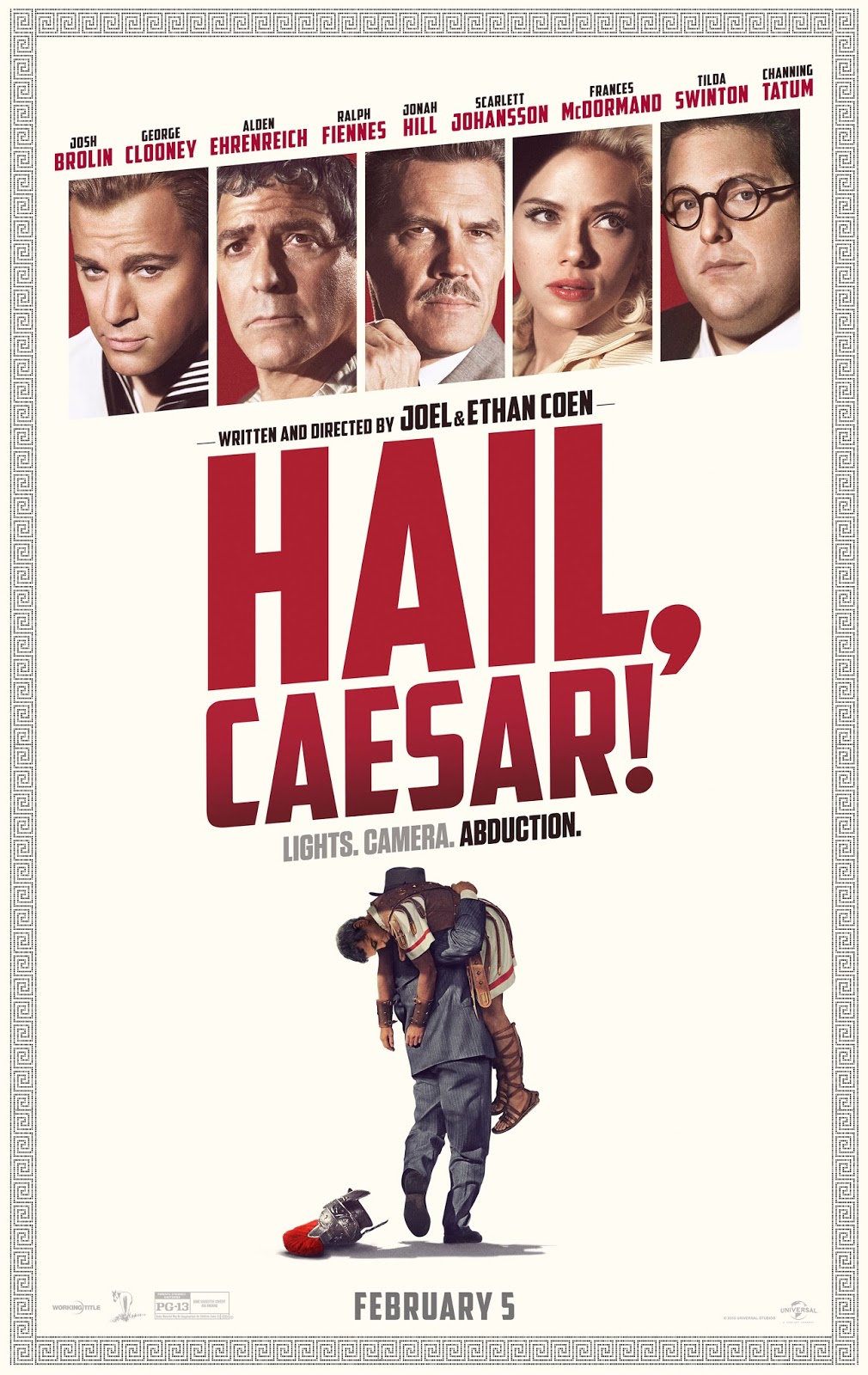
Hail, Caesar! (Release Date: 2-5-2016)

        There are supposedly two distinct types of Coen Brothers movies: the serious ones, and the fun ones. More so than any modern directors not named Steven Spielberg, Joel and Ethan's filmography alternates between the silly and the straight-faced at an almost perfect 1:1 ratio. Their dour noir debut, 1984's Blood Simple, was immediately followed with the wacky mania of Raising Arizona, just as Cannes film festival sensation Barton Fink made way for The Hudsucker Proxy's manic screwball energy, Oscar-winner Fargo begat legendary stoner comedy The Big Lebowski, and their most widely celebrated work to date, No Country For Old Men, served as a precursor to the laughter-inducing lark Burn After Reading. But where Spielberg refuses to allow intellect to spoil the fun of something like Jurassic Park, and finds little time or space for lightness of touch in either Lincoln or Saving Private Ryan, the Coens have always proven eager to let their paints mix. Humor and rumination are immovable mainstays of their every work, and while one is usually prioritized over the other, you don't have to squint to observe them working in concert with one another. As a matter of fact, you could just go buy a ticket to Hail, Caesar!

        A multi-layered foray into Hollywood of the 1950's, Hail, Caesar! portrays a hurried, harried 36 hours in the life of Eddie Mannox (Josh Brolin), a tinseltown 'fixer' employed by Capitol Pictures. Though his job takes him to the sets of snobby period pieces, aquatic pageants, and flamboyant musicals, Mannix's main concern is a swords-and-sandals epic from which the Coens' film takes its name, a tale of the Christ as witnessed from the prospective of a Roman soldier. The lavishly-budgeted production is thrown into chaos when its silver-screen superstar Baird Whitlock (George Clooney) is kidnapped from the set, a ransom note demanding a tidy $10,000 left in his wake. Mannox goes about locating his captor, all while being summoned in innumerable directions to put out the myriad of fires that the studio's various departments continuously ignite with fervor and reckless abandon.

        Ludicrous occurrences and genre-hopping relish aside, there's something about the both the tone and pacing of Hail, Caeser! that immediately butts heads with the zippy, zany flick that its trailers seemed to promise. Unplanned pregnancy and domestic violence are both on the table in the film's early goings, not to mention a roundtable discussion featuring higher-ups from diverging Abrahamic faiths debating the ethics and accuracies of portraying Jesus on celluloid. There are too many spinning plates on hand to properly explore any of these notions, but the film at large isn't in a rush to get away from them either, relaying its story in a steady, mid-tempo time signature. Where the likes of Aaron Sorkin and Martin Scorsese (not to mention the Coens themselves) have fitted their walk-and-talk dramas and comedies with a break-neck speed, Caesar brings the RPMs way down, the flapping lips and moving feet progressing in pseudo-slow-motion. Much of the comedy is welcomely broad, but the proceedings always feel more earnest than urgent, collectively toying with some knotty ideas that only come into focus near the film's conclusion.

        Don't mistake this as a claim that Joel and Ethan are asleep at the wheel during the interim; the brothers may be driving at a cost-effective speed, but when it comes to the places they visit, no expenses are spared. Each of the aforementioned movies-within-the-movie is dazzlingly realized, exquisitely mounted, and deeply-steeped in affection for 'the old ways' of doing things, to the point where brazen satire and heartfelt homage somehow merge into one another. Production Designer Jess Gonchor, along with Set Decorator Nancy Haigh and Art Directors Cara Brower  and Dawn Swiderski, deserves endless praise for locating such a specific brand of lived-in artifice, while Mary Zophers may well be the front-runner for next year's Best Costume Design Oscar. The whole venture is immaculately tactile, a veritable cinematic playground featuring a slew of today's most respected actors behaving as if the bell just rang, and recess has finally begun.

        Metro-Goldwyn-Mayer, the film studio from which the fictitious Capitol Pictures gains its inspiration, famously claimed to have "more stars than there are in heaven," a boast which the Coens seem determined to back up with their most famous cast to date. Brolin is captivating and surprisingly intense, and Clooney's wide-smiling imbecile proves perfectly in line with his previous Coen collaborations, but it's the rest of the cast that really pops. Scarlett Johansson, Jonah Hill, and Frances McDormand are each outstanding in their miniature roles, while Ralph Fiennes and Tilda Swinton ascend to the level of note-perfect with similarly bite-sized amounts of screen time. Relative unknown Alden Ehrenreich somehow manages to stand out amidst this bevy of Oscar nominees with a performance that would be both the film's funniest and most charming... if Channing Tatum wasn't here. His lone musical number is delightful enough to make time stand still, not to mention the unpredictable turn his character takes in the film's final act. For prolonged stretches, it feels like half of Hollywood is here to serve that great, glittering ideal that is entertainment.

        Their offerings combine to clarify the film's thesis without distracting from its meat-and-potatoes entertainment value, operating in tandem with rampant musings on religion, politics, media, and that blank space in the heart of man that the Coens have made a career out of exploring. Hail, Caesar! is a film about faith, and about service in the name of faith, a nebulous proposal that's always floating around the movie's margins, before you have a clue that it's even there. Each of its characters is dying at the alter of something, whether it be journalism, war, economic ideologies, public perception, or any of the aforementioned causes. They're all fighting for something they believe in, even if, as is frequently the case, they have only a fleeting grasp on what exactly that is. Staring down into that infinite black hole that is purpose has always been at the forefront of the Coens' movies, each with a slightly different shade than the next. Hail, Caesar! is no different, and while ignoring its theological wrestlings in favor of its off-kilter joke telling is entirely possible, I for one take umbrage with the 'minor Coens' tag with which it's been saddled. The film is gorgeous, funny, and stuffed to the brim with serotonin-triggering performances. It just so happens that when you're the Coens, even a rollicking comedy is worthy of deep, soul-searching analysis.

Grade: A
     

Saturday, December 19, 2015

Star Wars: The Force Awakens (Release Date: 12-17-2015)

        A long, long time ago, in a galaxy far, far away... a filthy, exhausted, and frustrated Luke Skywalker attempted to lift his X-Wing out of the treacherous Dagobah swamp using only the force. With victory in the palm on his hand, the Jedi in training experienced a lapse in focus and confidence, and watched his star ship sink back down into the murky depths. When Yoda, his wise, pint-sized master, implored him to try again, Luke simply answered "You ask the impossible." I've never felt quite as much like young Skywalker as I do right now, two days removed from my first viewing of J.J. Abrams' Star Wars: The Force Awakens, and attempting to write a worthwhile film review without spoiling ANYTHING. The film series that George Lucas brought to life back in 1977 has developed a following that, more so than any other in the history of cinema, borders on religion. Were I to ruin any of the events that take place in the movie, I could be force-choked in front of a crowd of people, and no one would lift a finger. And frankly, I would deserve it. In my near-28 years on the Earth system, I cannot recall a single film generating this level of feverish anticipation, and experiencing the movie myself only reiterated the importance of going in with as little pre-existing knowledge as possible. Difficult as it may prove, I hereby promise to not reveal a single thing about The Force Awakens. This is no laughing matter; there will only be doing, and strictly no trying.

        The seventh entry into everyone's favorite intergalactic saga begins with... wait, damn it (is it a spoiler to say that, at one point, it begins?). The inclusion of a summary in any movie review serves the simple purpose of cluing a reader into wether they might be interested in the story at hand, which makes The Force Awakens the perfect review in which to bypass one entirely. There have already been 6+ hours of Star Wars movies for everyone to decide if they're in or out on this space-set odyssey (13+ if you really want to include those other ones), and I've got a funny feeling that revealing the whereabouts of C-3PO isn't really going to move the needle one way or the other on that issue. People know Star Wars the way that they know language, not as something that they learned at a specific point, but a tale that's been recited since near infancy, and thereby wholly entrenched in the brain trust of popular culture.

        This makes adding anything to the universe both terrifying and tantalizing, but I'm here to tell you that those reservations can finally be set aside. The Force Awakens might not be a perfect movie, but I would argue that its casting actually is, ushering in a new slate of heros and villains to love and despise for years to come. It's a very rare thing to actually witness a star be born on screen in a single two-hour sitting, but in Episode VII, it happens twice-over. Where in the galaxy has Daisy Ridley been hiding all this time? The young Brit is like a magnet to the eyeballs, and if fans have retroactively appropriated Leia as a feminist icon, wait until they get a load of her performance as Rey. Then there's John Boyega, who vacillates between wonder, fear, snark, and joy without any discernible effort. Anyone starring in a Star Wars movie will inevitably have their name permanently etched in the history of cinema (Jake Lloyd, anyone?), but this is different. As of this writing, both are only 23 years old, and if both aren't legitimate movie stars for at least the next decade, you can freeze me in carbonite.

        When it's all said and done, it's Ridley and Boyega who truly stick with you, but that's not to say the other new additions aren't sublime. Oscar Isaac makes the most of his limited screen time as... wait... never mind. Then there's Kylo Ren, perhaps the film's most intriguing and multi-faceted new character, whose every action will stir up feverish conversation and debate until Episode VIII arrives in 2017. No such controversy will exist for BB-8, that soccer ball of unstoppable adorableness who gives Wall-e a true roll for his money as to who's the cutest robot in the last decade of film. None of these glorious new characters would exist without Lawrence Kasdan, the scribe behind both The Empire Strikes Back and Return of the Jedi, whose name we have not heard in a long, long time. He brings the same understanding of how to create interplay between lovable characters into this film as he did the last two, and Abrams' crisp visual aesthetic and preference toward practical effects make him unthinkably well-suited to steer the ship. Fans of the original series may take umbrage with his pacing, which is fast enough to make the Kessel Run in less than 12 parsecs, but with his preternatural understanding of how to create endearing characters and immediately engross an audience, there's little denying that he was the perfect person to bring Star Wars into 2015.

        Yes, everything that's new sparkles and shines, but some of the old stuff keeps The Force Awakens from fully ascending to the delirious heights of its predecessors. I'm of course only allowed to dip my toes in the waters of this idea without ruining my spoiler-free promise, but suffice to say, I think the further this new series moves away from its forbearers, the better. This is perhaps a bigger problem than I can really get into here, but this movie is capable of putting that kind of critical thinking on the back-burner for the majority of its runtime. As anyone who's already seen the film can attest, there's strikingly little that can be elaborated upon without drawing some severe ire from all who have not yet had the pleasure, but the latest entry is pretty damn good, and left me with three impressions that I feel safe in sharing: the new cast is phenomenal, I wanted to watch it again almost immediately, and it genuinely felt like Star Wars, and that's a presence I have not felt since... well, this. That's right people; we're home.

Grade: A-

Sunday, December 13, 2015

Brooklyn (Limited Release Date: 11-4-2015)

        The last 20+ years of technological advancements have been the death knell for a great number of things, and yes, this claim goes beyond the demise of Blockbuster Video. Privacy has become almost impossible to maintain, old notions of stardom and how it is attained have withered and died, and immediate access to digital reservoirs of statistics and data have changed the way we consider and converse. Perhaps the most jarring shift into our new world is the relative eradication of space. While it would take literal magic to render hundreds of miles of distance superfluous, global communication is not only available, but immediate, a concept that would have melted the brains of previous generations to even consider. The immigrants from all over the globe that essentially served as the bedrock for modern America were made to feel that distance, to be devastated by that distance, and to be changed by that distance. The new film Brooklyn may be devoid of any cloying "when I was a young girl..." framing devise that would make this point more literal, but it doesn't need it. You feel that space in every frame.

        Saoirse Ronan stars as Eilis, a young woman living in the Irish countryside in the 1950's who wants more out of life than to merely serve at the local shop. With the help of her sister and a few church higher-ups, Eilis secures a position in a boarding house in Brooklyn, as well as a gig at a city department store. It's not long after her oceanic journey that homesickness sets in, with an entire world swirling around her at twice the speed to which she'd become acclimated, letters from home taking eons to arrive. A glimmer of hope shows itself in the form of a suitor, an Italian boy named Tony (Emory Cohen) with a surplus of charm, patience, and flattery to his name. The vast expanse of New York and America at large is only starting to make sense when word from overseas requires Eilis to return home, and in the process casts doubt upon just where home really is anymore.

        Like its fellow Best Picture aspirant Spotlight, Brooklyn is nothing if not basic. No cameras zoom around with kinetic zest, no character is revealed to have secret devious motives, and the edits all come at a steady, unglamorous pace. What director John Crowley's movie does have, however, is class, one of the hardest things for a film to attain without becoming stale or overly familiar. It bares the stately, wholesome worldview shared by many of the films released in the era it attempts to recreate, finding beauty in simple framing, and subtle narrative shifts. Crowley's in perfect lockstep with Nick Hornby, the famed author of the books behind the movies High Fidelity and About a Boy who's really made a name for himself as a screen writer in the last handful of years, having been the pen behind both An Education and Wild. His script is wistful, romantic, and filled with soul, never overstepping the boundary into sappiness, leaving Crowley and (more importantly) the actors enough space to leave equally indelible marks on the story.

        And leave marks they do. The aforementioned Emory would come off as smarmy if his performance wasn't so delicate, and Jim Broadbent brings an almost angelic quality to his miniature role as Eilis' stoic guardian, Father Flood. The people who color in the margins are uniformly strong, but this is a true coming out party for Ronan. Her character's nervous energy and soft-spoken nature disallow anything showy from of her performance, and the Oscar nominee is up to the task, conveying wells of emotion and contemplation with the subtlest of gestures. The movie at large is similarly in love with her work, cinematographer Yves Bélanger constantly honing in on her face, enamored with every smile and glance. Ronan has had several winners to her name ever since her coming out party in 2007's Atonement, but Brooklyn announces her graduation from child actor to one of the world's premiere English-speaking thespians.

         The specificity of her performance is worth the price of admission, but Crowley isn't satisfied to rest on his laurels. Brooklyn is the movie that takes place after all the ones we've already seen; after Will Hunting goes to see about a girl, and after Ben Braddock gets on that bus with Elaine Robinson. Rather than focus on the courage and consideration that inspired her initial move, it captures the feeling of being a little person in a big, bright world, and the terror of being so far removed from everything you've ever known and loved. It's a frightening existence that technology has largely hidden from the modern world, but somehow Ronan, Crowley, and crew know how to take you back to that place, and make you feel the miles of salt water that separate one home from another. I can't even imagine how affecting it would be to someone who had lived through the era which the film depicts; it did a number on me as is.

Grade: A-

Monday, December 7, 2015

Spotlight (Limited Release Date: 11-6-2015)

        There is nothing inherently surprising about the events that take place in Tom McCarthy’s new movie Spotlight. The story chronicles the Boston Herald’s 2001 investigation into the Catholic Church’s decades-spanning cover-up of sexual abuse and molestation, a truth that has since been brought to light in a very public way. The investigators investigate, the writers write, and higher-ups in the fields of law, politics, religion, and media all pursue a variety of disparate agendas. No single character steps wildly out of line in either their personal or professional lives, each diligently working on behalf of a cause, which results in turning the movie into that rarest of things. While most of the very best flicks require largely unforeseen twists and turns to keep their audience engaged, Spotlight employs no such tomfoolery. It stands proudly as top-notch filmmaking and story telling by carefully and confidently relaying an important narrative, and requires nary a gasp or head turn to keep you fully engrossed on every imaginable level.

        Michael Keaton, Mark Ruffalo, Rachel McAdams, and Brian d'Arcy James star as the Boston Herald’s Spotlight team, a group of reporters tasked with conducting prolonged, thorough investigations in Massachusetts' state capitol, only turning in a very small handful of pieces per year in order to maintain the meticulousness of their fact-checking. The paper at large is shaken by the arrival of Marty Baron (Liev Schreiber), an impossibly stoic outsider to the city with a reputation for budgetary rigor and no non-sense leadership. Sensing an untapped story, Baron calls into question a recent report on the alleged nefarious actions of a local priest, and not only demands the Spotlight team to suspend their current project in favor accumulating further information, but also sets out to sue the church in order to receive pertinent documents that have since been legally classified. The local Cardinal takes umbrage with the Globe’s further snooping, setting in motion a struggle to reveal the whole truth, and nothing but the truth.

        McCarthy is also searching for a purified form of truth, which he locates by refusing to dress up the tale with either showy directorial choices or exaggerated portrayals of the true-life events. His guiding hand may be almost invisible, but it’s just as absolute; there might be little-to-no figurative fireworks in the film’s runtime, but everything keeps clicking so perfectly into place you might mistake it for a two-hour long Rube Goldberg machine. The script, written by McCarthy and Josh Singer and almost assured the Best Original Screenplay Oscar come February, is similarly economic, and has room only for scenes that advance the plot, or deepen our understanding. Other creative teams might have juiced up the tragic nature of the events with loudly delivered scenes of amped up, theatrical emotion (see: Oscar Bait). McCarthy and crew understand the intrinsic weight of the story, and their all-encompassing restraint only ensures that the whole thing hits that much harder.


        This emotional underplaying is made possible by the film’s decision to focus on the reporters much more often than the perpetrators, a choice that is bolstered at every turn by a stellar cast. While Ruffalo appears to be reissuing his Foxcatcher performance for further evaluation, Keaton and McAdams are subtle and strong from first frame to last. Schreiber is something different; he under-sells Barron to such an extent that he might even be over-selling. It’s that rare performance where an actor does so breathtakingly little that every slight movement seems gigantic in nature. His Zen-fueled self-presentation never flags, and neither does the movie's. They each know what needs to be done, and proceed to do it with steady, sure-minded confidence. As it turns out, that kind of thing can be a spectacle unto itself, no unforeseen twists or figurative fireworks required.

Grade: A

Sunday, October 18, 2015

Bridge of Spies (Release Date: 10-16-2015)

        For the last 30 years or so, Steven Spielberg's filmography has been a tale of two divergent directors. Already a soaring, generation-defining success after crafting such instant classics as Jaws, Close Encounters of the Third Kind, Raiders of the Lost Ark, and E.T., Spielberg first tried his hand at 'serious filmmaking' with 1985's The Color Purple, a flick that was rewarded with 11 Oscar nominations (and a still-infamous zero wins). While the commercial, popcorn-friendly side of the filmmaker was still at large as recently as 2011 (The Adventures of Tintin), the last three decades have seen a pretty even split between Steven Spielberg-King of the Blockbuster, and Steven Spielberg-Master of the Prestige Picture. The divide has proven strikingly absolute; the auteur's fluffier stuff has possessed little room for real-world allegories or political point-making, while the more straight-faced affairs hardly ever crack a smile. His latest, Bridge of Spies, almost demands that you show reverence while buying a ticket, barring its 'Message Movie' identity almost as blatantly as its desire to win golden statues.

        National treasure and awards season heavyweight Tom Hanks stars as James Donovan, an insurance lawyer in mid-50's Brooklyn who, in the film's opening passages, is tasked with a doozy of a case; defending known Russian spy Rudolf Abel (Mark Rylance) in a court of law. After several meetings between the two, Donovan's initial reluctance turns into empathy and intrigue, prompting the lawyer to focus his considerable energy and intellect on saving the man's life. The American public is appalled by his efforts, but in helping Abel avoid the electric chair, Donovan wisely foresees an opportunity to save a captured American in a civil hostage exchange. His prediction comes to fruition in the form of downed spy pilot Francis Gary Powers (Austin Stowell)... as well as mistakenly detained American economics student Frederic Pryor (Will Rogers). Negotiations for a two-for-one swap begin immediately, with Donovan suddenly finding himself firmly entrenched in the Cold War conflict.

        The trailer for Bridge of Spies covers all of its standard Academy Award aspirant bases; serious, real-life subject matter, a gorgeously-rendered depiction of yesteryear, household names in front of the camera, and a legendary filmmaker behind it. What they fail to convey, however, is just how fun the film is to watch. Bucking the previously described binary that's come to define his recent work, Spielberg is clearly having a blast here, relaying a simple, inspiring story of wit and bravery under extreme circumstances. Compare this to his recent attempts to tell the story of our country's most iconic president (Lincoln), and portray the vast entirety of WW1 as a lyrical John Ford film (War Horse), and this is a decidedly smaller undertaking.

        Shedding some of that weight has enlivened every facet of the helmer's work, from the engrossing pace established by editor Michael Kahn, to the immediately believable production design of Adam Stockhausen, to Matt Charman and the Coen brothers' ceaselessly engaging script. Even cinematographer Janusz Kaminski, whose previous collaborations with Spielberg have born one sedated, over-saturated image after another, sends his camera flying around the room, capturing the proceedings with zest and visual curiosity. This is undoubtably a 'Serious Steven Spielberg Movie,' but they must have finally snuck an espresso machine onto the set; for the first time in years, there's a real sizzle to the industry titan's work.

        The humming of the engine isn't regulated to the production department. Rylance is almost assured an Academy Award nomination for his deft, stoic, chuckle-worthy turn here, though his involvement in the film's proceedings lessens in the movie's second half. Hanks' role never wains even slightly, Donovan proving the lone constant in a tale chuck-full of moving parts. Like Matt Damon in The Martian, this is the kind of performance that's exclusively suited for a legitimate Movie Star, immediately and consistently attaining audience sympathy and trust with his warm familiarity. In fact, the comparison to The Martian works all the way down the line; both are feel-good films positing an idealized civility between all humans, starring an iconic thespian, and directed by highly-regarded individuals who haven't seemed this clear-eyed and invested in years. Spielberg might still be two filmmakers rolled into one, but in Bridge of Spies, we finally get to see them work in concert with one another, and the results are vivacious and heartening.

Grade: B+
       

Monday, October 12, 2015

The Martian (Release Date: 10-2-15)

        Christian Bale, Joel Edgerton, Sigourney Weaver, Ben Kingsley, Michael Fassbender, Brad Pitt, Cameron Diaz, Javier Bardem, Penélope Cruz, Charlize Theron, Guy Pearce, Russell Crowe, Cate Blanchett, William Hurt, Leonardo DiCaprio, Chiwetel Ejiofor, Josh Brolin, and Denzel frickin' Washingston. What do all of these Hollywood stars have in common? They each starred in a Ridley Scott flop... and all within the last decade. The director of such classics as Alien, Blade Runner, and Gladiator has fallen on hard times, and we're not talking about a two or three movie slump here. With the exception of the aforementioned Swords and Sandals epic, the auteur has hardly made anything of note since the turn of the century, and yet his latest feature sees the stars aligning once again, as The Martian can boast of a cast featuring Matt Damon, Jessica Chastain, and a slew of other faces familiar to the big screen. It's probably not random that only two of the thespians listed in this paragraph's opening have gone on to appear in additional films from Mr. Scott, but hey, the Cubs might win the world series, so why can't Ridley get back on the horse?

        Damon stars as Mark Watney, the botanist of a six-man crew conducting scientific experiments on the surface of Mars. A devastating storm forces the crew to leave the planet, but the red sphere isn't the only thing in their wake; left for dead amidst the chaos and carnage, Watney awakes to find himself all alone, 54.6 million kilometers away from the orb he calls home. NASA director Teddy Sanders (Jeff Daniels) announces the tragic, misinformed news of Watney's death to the press, only to have his information refuted by a series of curious satellite transmissions. With the public clamoring to bring the ill-fated astronaut home, Watney sets to the business of surviving, relying almost exclusively on his knowledge, irrefutable can-do attitude, and a few scraps left behind by the crew.

        The first and most obvious observation one could make about Ridley Scott's latest is that it feels absolutely nothing like a Ridley Scott movie. Sharp, snappy, and containing nary a wasted moment in its 144 minute runtime, The Martian almost argues against some of Scott's most impactful filmmaking, which tended to favor slow-bore movements and imagery that almost hypnotized his audience. His latest would rather keep your pulse running, and, in an even bigger surprise, your knees slapped, and your sides in stitches. It's not that The Martian is gut-bustingly hilarious or anything, but it's consistently jovial and snicker-worthy, which is worlds removed from not just Scott's filmmaking canon, but the 'isolated individual' genre in general. Movies like Cast Away, Buried, 127 Hours, and Gravity allot hefty portions of their runtime to showing both the panic or mental deterioration of their protagonist. The closest The Martian gets to that sort of existential crisis is forcing Watney to endure entirely too much ABBA. Positivity and intellect are this character's driving forces, and those two pillars of stability leave precious little room for doubt or despair. This is, of course, unrealistic for a man marooned on a foreign planet, but wholly in keeping with the film's larger argument.

        There is a moment, when Daniels' character is first confronted with the news of his error, in which you fear some nefarious intent on the part of those on the ground, and in power. It comes, and then it goes, replaced by sweaty-palmed, all-hands-on-deck approach to saving our protagonist from the depths of space. My single favorite aspect of last year's Big Hero 6 was the film's setting of San Fransokyo, of futuristic melding pot of a city that abided by any gender, color, or creed, and celebrated, above all else, the beautiful possibilities man is afforded by their dazzling intellect. The notion was a breath of fresh air in a movie landscape choked-out by a misery-mongering view of the future, and while this summer's Tomorrowland continued Disney's side of the argument, it's The Martian that posits this notion most effectively. When Watney's old crew hears that they may be able to help, everyone agrees to take action almost immediately. When the U.S. questions how such an elaborate feat could be accomplished, China is there to help. A young female intern has her profile boosted because of her outstanding output at the NASA control center, and a young black physicist, for all intents and purposes, offers the single best solution to the narrative's problem. It's a gorgeous, hopeful take on the future, one that will doubtlessly attract naysayers who decry the film's lack of realism, but I for one was completely taken by the movie's dedication to portraying the very best in people, and doing so in an all-inclusive manner.

        Yes, having Matt Damon, one of cinema's foremost depictions of white privilege, star in a film about how the whole world should just get along already, seems problematic on paper. Thing is, this very well might be the role he was born to play. Charming, self-aggrandizing, and self-depreciating in nearly equal measure, Damon doesn't embody a real person (or Watney, for that matter) so much as he conveys Matt Damon: Movie Star. If the film at large plays like a Frank Capra film, believing in the best side of people and affording them autonomy at every turn, then Damon is its own personal Jimmy Stewart, an 'ah-shucks' good guy whose real-life star power influences nearly every frame. You've seen him as 'the kid' swimming with the Big Boy con sharks, an endlessly lethal and wounded super agent, and a smarmy double-agent to boot; The Martian is fully aware of Damon's pre-existing filmography, and embraces audience awareness at all times. The allure of his star-power and sure-handedness are too much to resist, even his barrage of eye-rolling 'dad jokes' working in the movie's favor. As strange as this is, I would wholly welcome a Best Actor nomination for Damon despite believing that you could hardly call this acting. Plenty of folks can bring characters to life in convincing fashion; it takes a special talent to 'perform' so little, and yet accomplish so much. 

        There are other accolades to hand out, ranging from Drew Goddard's lively script, to Pietro Scalia absolutely electric editing. But in thinking about the film, I keep coming back to Scott, a director who I personally had completely given up on, crafting one of the very finest films of his illustrious career, and reinventing himself along the way. A few f-bombs keep this film from being rated PG-13, but the truth of the matter is that this is a family film at its core, inviting at every turn, and with its heart always in the right place. In as far as pure entertainment is concerned, you could hardly do better than The Martian, one of 2015's best films to date.

Grade: A-
       

Sunday, October 4, 2015

Sicario (Limited Release Date: 9-18-2015)

        The films of Dennis Villeneuve are not for the faint of heart. His directorial debut, 2011’s Best Foreign Film nominee Incendies, dealt with atrocities of war and unspeakable suffering. His follow-up, Prisoners, is a child abduction epic that refuses to bat an eye even when things get grisly, and last year’s Enemy provided a cryptic puzzler about identity and self. But despite their consistent level of intensity, the thing that truly ties all his pictures together thematically is their exploration of how far a person will go to find the truth. His protagonists, always less than self-assured as their journey begins, can’t help but become so engrossed in the narrative’s central mystery that the world around them begins to fade away, taking the character’s very soul along with it. Sicario marks his third feature in as many years, and asks Emily Blunt to look down into that same dark, infinite abyss where all of his lead actors have eventually found themselves staring. Young as his career may be, there’s little use in denying that Villeneuve is the modern day poet laureate of the Rabbit Hole.

        Blunt stars as Kate Macer, an FBI Special Weapons and Tactics officer with a reputation for never batting an eye, even when things get gruesome and/or violent in the bleached-out Arizona desert she calls home. Her proficiency in even the most horrific of events catches the attention of Matt Graver (Josh Brolin), a Department of Defense adviser (by way of snake oil salesman) who wants to recruit Macer into help bring down a higher-up in the ever-escalating drug war taking place on the border between Texas and Mexico. She agrees despite receiving minimal intel on just what the mission will come to involve, and is further perturbed by the presence of Alejandro (Benicio del Toro), a weathered warrior who serves as Graver's partner despite a lack of any real professional title. And down the war-torn, savagery-abiding Rabbit Hole they go.

        The less you know about Sicario going into it, the better, but I will say this; Villeneuve wastes no time in ratcheting up the tension. These are two of the most intense consecutive hours of filmmaking in recent memory, and while the story it tells undoubtably takes place in the realm of reality, the merciless tension and expert craft involved relay the tale as a fever dream, or terrifying hallucination. Cinematographer Roger Deakins (again at the top of his game, because when isn't he?) undulates between unnerving close-ups and uncompromising explosions of color. His camera fashions the world as painter's canvases do; with emotions and sensory overload working together to create a space that is at once recognizable, but also captivatingly surreal. Composer Jóhann Jóhannsson, Villeneuve's previous collaborator on Prisoners, is also responsible for the light sweat you feel in your palms from first frame to last, trading out his normative eerie beauty for something raw, primal, and foreboding.

        As most great filmmakers in history would likely attest, much of Villeneuve's success comes from surrounding himself with talented individuals, and while the last paragraph sings the praises of those involved behind the camera, those in front of it are performing just as brilliantly. The obvious accolades go to del Toro by simple virtue of having the meatiest role, and between Traffic, Escobar: Paradise Lost, and this, the thespian has clearly established himself as the most important actor in American cinema's depiction of The War on Drugs, having now played a character stationed at nearly every side of the fight. For my money though, the film's stand-out supporting turn is contributed by Brolin, an actor most familiar as a stoic sort rather than the smiling sleaze he inhabits so naturally here. His performance would almost make you sick if it weren't so devilishly delicious. Then there's Blunt, who, despite being the film's avatar for the audience, has the least involvement in the events on screen, and yet still manages to be the stand-out. Those who loved her violent, futuristic Joan of Arc in last year's Edge of Tomorrow would be wise to curb their expectations. She's certainly still a badass, but is subject to a tremendous amount of abuse, both physical and emotional, from which she suffers deeply. She's no slouch when it comes to dialogue delivery, but it's what her face does in moments of silence and intent observation that make her a likely Best Actress nominee at this year's Oscars.

        If you're looking for a review that offers more concrete information and elaborate description of Sicario's plot and the arguments made during its runtime, you'll have to click elsewhere. If it's not perfectly obvious by now, I was blown away by this film, and out of respect, my write-up will be free of any spoilers, or hints that might have you resolve the movie's twist before it arrives. And yes, I did just give away that there is a twist; the movie offers up that information on a silver platter, del Toro even saying to Blunt in the early goings, "Your American ears won't understand, your eyes will see things that make no sense, but in the end, you'll understand." This is certainly true of Kate Macer, who is shown the light by Taylor Sheridan's twisty, unpredictable script, but perhaps more so by the awe-inspiring talent of her director. It's difficult to put a finger on exactly how Villeneuve elevates this film to the lofty tier where it resides simply because every single aspect is brought to life with such mesmerizing aplomb. Dennis Villeneuve is one of the finest filmmakers currently at work, and Sicario may very well be his best work to date. If gore, intensity, or pessimism are deal-breakers for you, I'd pass on this. For literally anyone else, this is must see cinema. Go watch it on the biggest screen you can find.

Grade: A

Monday, August 3, 2015

Mission: Impossible - Rogue Nation (Release Date: 7-31-2015)

        Hollywood's annual summer blockbuster season isn't exactly known for showcasing crackling dialogue, but the last few months have turned that stereotype into a manifesto. The Avengers: Age of Ultron, the assumed champion of the 2015 box office upon its May 1st release, tried to jest, jab, and joke its way to the financial throne, only to be usurped by a flick with nary a clever line to its name. Inside Out, Pixar's magnanimously thoughtful, philosophy-spewing exploration of the adolescent human mind, is certainly a monetary success story, but it's presently being outpaced by those gibberish-spouting motormouths known as the Minions. The critical darling of the season hardly had time for anything besides the grinding of engines and the burning of gasoline, least of all being small talk. There's been a Silent Film quality present in many of our most treasured offerings of the last 100 days, and Mission:Impossible - Rogue Nation is here to carry that trend even further.

        Since the film does manage to make time for a plot, I suppose I'll go ahead and carve out space for its description. Picking up where 2011's gloriously imaginative Ghost Protocol left off, Rogue Nation finds Tom Cruise, Tom Cruise playing Tom Cruise, Tom Cruise with a different name, Tom Cruise playing a character who's not named Tome Cruise, but is clearly based on Tom Cruise, Ethan Hunt (played here by Tom Cruise) still on the lam from the CIA. The Agency's director, played by Alec Baldwin, is hell-bent on dissolving the Impossible Missions Force from which this series gains its name, citing 'wanton brinksmanship' and 'disregard for protocol' as the group's primary characteristics. He has it out for Hunt especially, but so does The Syndicate, a mysterious group of terrorists whom Ethan's been tracking for months, getting closer and closer by the day. His investigation leads him to Ilsa Faust (Rebecca Ferguson), a mysterious, lethal beauty whose true allegiances she might even be keeping secret from herself. Cue that irrepressible, decades-old Mission:Impossible theme song, and so, so, so much running.

        Prior to Rogue Nation, I wouldn't have described myself as an avid Mission: Impossible fan. Yes, Ghost Protocol is an action picture that can confidently stand next to the best in the genre's history without batting an eye, but the third entry didn't exactly knock my socks off, and the first two are simply too far in my personal rearview mirror to state an informed opinion. All of this to say, the prospect of yet another MI picture was strictly a modest curiosity when the lights went down at my screening, and yet, less than 48 hours after walking out of the theater, I feel fully confident that I will never miss another entry. With the exception of a dragging 15-minute stretch that starts around the 80-minute mark, this movie slapped a smile on my face that was big enough to make my cheeks ache by the time it was finally over.

        If there's any complaint to be made about Cruise's newest savior-complex-enabler, it's to be found in the previous sentence, specifically in the word 'finally.' Rogue Nation is non-stop in a fashion that borders on insanity, and while its set pieces might not match the awe-inspiring glory of director Brad Bird's previous installment, the minutia of how our characters get from point A to point B is immediately more white-knuckled, and pulse-pounding. These are, of course, compliments for a movie that aims to serve as a roller coaster first, and a proper film second, but its 131 minute runtime insures that you feel at least slightly weathered by the time the credits roll. It's an odd complaint given that none of the individual sequences is anything less than captivating, but if we're picking knits here, the picture could have better maximized its impressive impact by trimming the runtime by just a hair.

        Other than that, everything is gravy. The convoluted plot, while immediately as thorny and undulating as each of the previous entries, is easier to follow than its predecessors due to writer/director Christopher McQuarrie's graceful deployment of plot points and pertinent information. But something tells me it's not his pen that will cause film fans to view the helmer differently upon viewing his latest film. Excluding that aforementioned 15-minute stretch, Rogue Nation is downright obsessive about not wasting your time, powering through one intense action sequence after another with its hands firmly on the wheel, and its foot pushing the gas pedal to the floor. Editor Eddie Hamilton also deserves credit for the rousing manner in which it all goes down, slicing through the mania without losing the audience for any prolonged stretches of time. The newest Mission: Impossible is a blast, filled with fun actors, technical prowess, and an emphasis on practical effects that's capable of dropping jaws while computer animated mayhem is busy drawing yawns. Sorry, no Tom Cruise think-piece here; you could google almost any other review of Rogue Nation and find innumerable explanations of how the film works in conjunction with the actor's damaged public persona. There's certainly a lot to absorb in that arena, but I want to keep this write-up clear and precise, as to not lose the only MI5 argument I personally feel any dire need to get behind: Rogue Nation is freaking awesome, and if you haven't seen it already, go buy a damn ticket.

Grade: A-

Sunday, June 21, 2015

Inside Out (Release Date: 6-19-2015)

        When it comes to describing the frequently brilliant output of Pixar Studios, filmgoers generally don’t shy away from superlatives. Wether praising the beauty of their animation, marveling at how their stories appeal to all ages, or being dazzled by their seemingly instinctive knowledge of how to tug on heart strings, you’d be hard-pressed to find a single movie buff who isn’t impressed by their magical twenty year run. One aspect I’d argue is a tad under-discussed is their staggering level of ambition; this is, after all, the same group that dared to spin the first half of their dystopia epic Wall-e into a comedy from the silent film era, not to mention drawing enough tears in first ten minutes of Up to turn California green again. The seemingly effortless manner in which they present their art can often mask the bravery inherent to its undertaking. It’s been three years since their last original film (and five since their last good one), a span that has led audiences to wonder wether these storytelling savants might have finally run out of mold-shattering modern classics. If Inside Out tells us anything, it’s that John Lassiter and friends have heard your complaints loud and clear; Pixar’s latest is their most ambitious entry to date, and it’s not especially close.

        Charting the inner-workings of an 11-year-old girl named Riley, Inside Out employs five personified human emotions as its central characters: Joy, Anger, Disgust, Fear, and Sadness. The quintet work together in the control room of the preteen’s brain, each taking the reins in situations that befit their specific paradigms. The team is led by Joy, a radiant Tinker Bell descendant who prioritizes her effect on the girl’s mind to that of the other, more negative emotions. Their steady grip on Riley’s mental state is loosened finger by finger when the girl’s father lands a job in San Francisco, forcing the family to relocate from their beloved Minnesota. A squabble in head quarters finds both Joy and Sadness thrown into the depths of long-term memory and subconsciousness, leaving Riley with only Disgust, Fear, and Anger to navigate her new surroundings until the remainder of the team returns.


        The embodiment of key emotions is far from the only aspect of the human brain that the film seeks to literalize. Memories are imagined as glittering orbs that are harvested and stored according to their importance. Entire islands are erected in the name of Riley’s most prominent interests and intrinsic priorities. There’s even a moment when Joy and Sadness pass through the girl’s abstract thoughts in order to board the Train of Consciousness, on which they sort through boxes labeled ‘facts,’ and, ‘opinions.’ It’s heady stuff, and while Pixar films have always managed to leave a lasting impact on kids and adults alike, Inside Out is their first to do so on two completely disparate levels. The children in my theater appeared genuinely charmed by the picture’s manic physical comedy, as well as concerned during moments of peril, but the divide between their understanding of the film and that of their chaperones was palpable from first frame to last. Kid pics like Shrek and Shark’s Tale have managed this trick on a purely comedic level, but their narratives played the same for grown-ups as they did little ones. Inside Out is essentially two different movies playing at the same time, and the sure-handed way it accomplishes this feat is as bold as it is unique.

        Though I loved charting every movement in the film's endless metaphor, I couldn't help but wonder if children might actually understand the flick better than adults. Those fascinated by the infinite corridors and machinations of the human brain (see: almost everyone) will find it difficult to pay the purest off attention to the narrative at hand, and, like Sadness herself, might prefer to explore the the nooks and cockles of the movie's richly imagined mind. A sturdy amount of my time in the theater was spent wondering what would happen if both Joy and Sadness were lost forever in the subconscious, not to mention the effects of the catastrophic damage they seemingly cause with their every move. Are we witnessing concussions, moments of mental scaring, or just mental growth through destruction of the old guard? It's likely all three and more, and while the film is replete with intellectual intrigue, the mental gymnastics it inspires can sometimes distract from the picture's beating heart, as well as the events at hand.

        If this reads as a complaint that the movie simply has too many strong elements to keep track of in its brisk 94 minute runtime, that's because it is. Inside Out marks Pete Doctor's third Pixar outing to date, and while his latest isn't as visually dynamic as the delightful, imaginative Monster's Inc., or as purely emotional as the heart-breaking, life-affirming Up, it manages to retain all those same elements, and tether them to the studio's most daring entry to date. He deserves the attention shown to studio stablemates John Lassiter, Andrew Stanton, and Brad Bird, and in collaborating with Meg LeFauve and Josh Cooley, he might very well have created the first screenplay for an animated feature to be a front runner at the Oscars. This marks the second straight week in which a near-irrefutable crowd pleaser is being judged unfairly against a modern classic, and while comparing Jurassic World to Spielberg's game-changing original strikes me as particularly unreasonable, expecting every movie to be Toy Story or Wall-e is similarly unjust. Inside Out is a mind-bending adventure that will make kids laugh, parents cry, and prompt psychology professors to add a slap-stick comedy film to their syllabi. Don't call it a comeback; Pixar's been here for years.

Grade: A-

Sunday, May 17, 2015

Mad Max: Fury Road (Release Date: 5-15-2015)

        Even in a world where sequels and reboots rule the multiplex, it's still somewhat baffling that was ever made. Arriving in theaters a solid three decades after the most recent installment in the franchise, FR appeals to our collective cultural nostalgia for a slew of pictures that mean absolutely nothing to the young movie-goers who power the box office, and was budgeted at a whopping 150 million smackers. The collective gross of the three previous films: 68.6 mil (yeah, I know, that's not adjusted to inflation... just work with me here). Suffice to say, director George Miller's scrappy Australian action trilogy was not the only reason this new edition saw the (green) light of day. First, there's hollywood's wholesale re-appropriation of B-movie aesthetic, taking a previously scoffed-at corner of the film world, and enabling the likes of Quentin Tarantino and Robert Rodriguez (among many, many, many others) to apply both gloss and self-awareness to the blood-streaked pallet. Then there's the The Fast and the Furious franchise, whose perpetual revenue growth has taught tinsel-town one very important lesson: real cars and real stunt-work make for real fun. Given context, the bank-rolling higher-ups had ample reason to dust off this old property, and hope for Vin Diesel Unchained to torch the box office. Now that we've firmly established Fury Road's fiscal legitimacy, let's explore if this ever should have happened in the first place.

        Set an unknowable number of years after the events of the first three films, the newest Mad Max finds its titular hero (played here, for the first time, by Tom Hardy) in the most familiar of circumstances; alone, void of purpose, and desperately hungry for two-headed lizards. Perhaps a bit rusty from an unprecedented 30 years of paid leave, Max is captured by the War Boys, a collection of animalistic rough-riders led by their own personal demigod Immortan Joe (Hugh Keays-Byrne, veteran of the original Mad Max/famed ice cream enthusiast). Our protagonist becomes the slave of Nux (Nicholas Hoult), a young religious lunatic hell-bent on accomplishing Joe's mission: capture and return both former trusted ally Imperator Furiosa (Charlize Theron), and the mysterious cargo she carries in her recently gone-rogue tanker truck. All other plot machinations can be heard in the roaring of engines, and the crunching of steel.

(*urg... please allow me a second to mount my High Horse... urg*)

       Ah, that's better. The 'action movie' is a broke entity of late, leaning too heavily on computer generated imagery, and mitigating the consequences of their omnipresent large-scale violence in the process. Fury Road lives to destroy this trend through pure force of will, following in the foot steps of the aforementioned Furious flicks in its stand against the over-use of artifice. The film makes frequent exceptions to its anti-CGI manifesto (including an awe-inspiring sand-storm sequence), but is ever-weary to balance them with the folding of real metal, and the burning of true gasoline. Say what you will about the legions of effects artists that power almost all of today's mega-hits; there's something inherently cinematic and satisfying about watching a real car turn from hamburger into hot dog right before your eyes. The sensation speaks for itself.

        As much as I'd love to give further tithings to the Church of Hardy, it's not my man Tom's efforts that make this movie so special. Nor is it Theron's, despite giving life to an emotive, combative, bad-ass heroine for the ages; the film belongs to writer/director George Miller, and the astounding work of his behind-the-camera talent. That's right, George Miller, the same guy who directed Babe: Pig in the City and the two-part computer-animated odyssey of singing, dancing penguins that was Happy Feet and its sequel. Just when the 70-year-old filmmaker seemed to be lost in an endlessly swirling whirlpool of sap, Fury Road rages to life, surely the most fast-paced, maniacally-imagined, and breathtakingly realized action blockbuster in quite some time. His boundless, sadistic whimsy fuels much of the proceedings in a quite overt manner, which is why I feel compelled to highlight the running mates that made his nightmare come true.

        Fury Road is a quintessential 'Must Be Seen On The Big Screen' experience, thanks in no small part to John Seale's sun-soaked cinematography, never less than beautifully brutal, or strikingly visceral. His camera captures the desolate, blisteringly-orange wasteland with the same aplomb as it does the grueling, hellish citadel over which Immortan Joe presides, brought to stomach-turning life by production designer Colin Gibson. As spectacular as the sets and costumes might be, the main appeal here is the action, pummeling eye-balls and forcing hands to grip armrests as Junkie XL's overpowering score rolls right over you with the merciless certitude of a cement roller. Every technician in sight is on their A-game, which is perhaps why it's editors Jason Ballantine and Margaret Sixel, acting as our tour guides through this endless ocean of awesome, whose contribution stands out the most. Their pace is relentless, sweeping you up in yet another jaw-dropping moment before you're even done processing the last, all without sacrificing cohesion on either a narrative or physical level. Shots rattle off in rapid-fire succession, most lasting a couple seconds or less, and yet Ballantine and Sixel make sure that you always know who is where, and what they're doing. In a summer season recently bombarded with the likes of Transformers and any number of Marvel flicks, Fury Road's innate sense of spacial reasoning is not only impressive, it's largely unparalleled. If their names aren't called on Oscar nomination morning, there's simply no justice left in this world.

        If you're wondering why my effusive praise for the new Mad Max has been largely focused on the technical side of things, it's because my affections are as well. Fury Road's story is both solid and streamlined, appealing to real emotions without caking on saccharine romances or convoluted plot twists, but those who view George Miller's latest as some sort of feminist statement simply saw this one through an entirely different set of eyes than my own. I suppose it's there if you squint, but you can keep your eyes wide open and not miss the fact that much of the supposed intellectual feminist push comes from fashion models dressed in flowing white robes. Not every film with strong female characters should be seen as harboring an agenda (though a few morons will undoubtably argue otherwise), and just because Fury Road fits in a few obvious digs at patriarchy and the resilience of females under duress doesn't mean it's boldly subverting Blockbuster expectations, nor force-feeding us a message for that matter. Each character's actions make sense in context, and while looking at this or any other form of pop art in the light of altering social consciousness, Fury Road doesn't need a million internet think-pieces to just be a kick-ass two hours at the flicks. The story arch, and the players within it, are at least serviceable, and often great, but it's Miller and that endless cavalcade of names you read during the credits that actually reach the sublime. Their immense collective talents work to create the purest form of what every flick is trying to conjure, yet so few actually reach: Movie Magic.

Grade: A

Monday, August 11, 2014

Boyhood (Limited Release Date: 7-11-2014)

        Richard Linklater has been making feature films for the last 23 years, and we're only just now starting to figure him out. Undoubtably one of the most under-appreciated directors of his generation, Linklater's formal elasticity has helped him make minimalist art films (Slacker, the Before trilogy), layered character studies (Dazed and Confused, Bernie), rotoscope animation drama for adults (Waking Life, A Scanner Darkly), and live-action studio comedy for kids (School of Rock, Bad News Bears). This reluctance to be placed in any single box has threatened to become the very box itself, the auteur's insistence on variety serving as a defining trait of his filmography. Another is sparkling dialogue, as anyone who's melted over Jesse and Celine's crackling discourse, or poured over Waking Life's myriad of delightfully thorny ideas, can readily attest. With the release of Boyhood, the critical conversation has shifted to his obsession with time, the Before series having already incorporated the passage of literal years onto its fictional canvas, Dazed serving as a time capsule waiting patiently to be unearthed. All theories are right in their own way, but I'm here to posit my own; Linklater's real love affair is with the notion of growth.

        Back in the summer of 2002, Linklater cast a 7-year-old boy named Ellar Coltrane in the role of Mason, a character who would take his cues from the young actor's real life, rather than the other way around. Over the course of the next 12 years, Linklater and his crew embarked on yearly visits to Houston, filming for about a week at a time on each occasion. Without a concrete script to work off, the filmmaker consulted with Coltrane and the other three leads (Patricia Arquette, Ethan Hawke, and Lorelei Linklater, the helmer's daughter), molding the story according to the real-life development of all of the actors, the kids especially. There is no plot, only a two-and-a-half hour window into the youth of a human being, resulting in a film that could somehow be described as either a dull bore or a towering epic depending on whom you're talking to. And since it's me who's talking, let's go with epic.

        I have never seen anything quite like Boyhood. The most obvious comparison is Michael Apted's Up documentaries, but those films, which check in on the real lives of the same handful Brits every seven years, observe the aging of their stars over the course of many chapters, and many hours. Watching this young boy grow into puberty and then approach manhood over such a relatively short period of time makes a real emotional impact, a special effect more awe-inspiring than anything a computer could ever make. One usually shies away from praising a film for its concept above its execution, but Boyhood is that rare instance where form starts to bleed into content. However riveting the story may or may not be, the experience of watching Coltrane stumble through that awkward, immediately relatable thing we call growing up, all while his parents develop both wisdom and wrinkles before our eyes, is undoubtably the most emotional aspect of the picture.

         Another oddly relatable property are the Harry Potter books and films, a collection of stories that featured growing characters/actors whose collective adolescence ran parallel to that of their primary audience. We certainly know that Mason is Generation Hogwarts, Boyhood oft-referencing the series, and even taking time to revel in the joy of a midnight release of The Half-Blood Prince. The picture is constantly dating itself in this manner, and while one wonders how these year-specific citations will effect the film in the future, they recall the impression and importance of pop art on young brains. The fact that six-year-old Mason loves Dragon Ball Z, 14-year-old Mason loves The Dark Knight, and 18-year old Mason reads Breakfast of Champions and jams out to Arcade Fire is neither a mistake nor a minor observation; his interests chart the moments that, at the time, felt important in popular culture, as well as our protagonist's continuing maturation.

         Casting a pair of children in a decade-plus film project is obviously a risky gambit, but for the most part, both Coltrane and Linklater come up aces. The latter grows from the sort of in-your-face precociousness youngsters often take on into an aloofness readily familiar on the faces of many young adults. Coltrane's journey is a bit more rocky; he proves endearingly observant and pensive during his single-digits ages, then morphs into a counter-culture punk, complete with greasy hair, painted nails, and forth-baked ideas on philosophy and society as a whole. I cannot say, in good conscious, that I liked teenaged Mason, but the brattiness that will undoubtedly turn off a multitude of viewers rings completely true to me. Some will claim that Linklater's writing drops off at this point, but all of the cringe-enducing self-satisfaction marks a recognizable point in adolescent development. Hawke and Arquette are perhaps even more wonderful, Arquette especially, as parental figures who attempt to steer their children onto the 'right path,' an agenda that eventually helps them locate their own.

        The last filmic comparison I want to bring up is Terence Malick's The Tree of Life, a flick which Boyhood will likely follow into a Best Picture nomination. No, there are no dinosaurs on hand this time around, but the way in which both filmmakers present childhood memories less as momentous occasions than a series of poignant minor moments strikes an awfully deep chord. Boyhood might not be electric entertainment from cover to cover, but neither is life. I usually don't like this argument, as it favors films that treat boredom as a sort of artistic virtue, but this is an entirely singular example. Linklater's piece isn't a slice-of-life movie with covert plotting and a relatable human cast; it's a slice-of-life unto itself, posing as a feature film. When most movies fail to intrigue for a few consecutive minutes, you start looking at your watch; when Boyhood hits a lull, you just sort of wait it out, just like you would analogous dull periods in your own life. The only things that come off inorganically are the start and the finish, and only because life lays claim to neither an explicit genesis, nor a definite conclusion, outside of the literal. Even after a slow-moving 165 minutes, the end credits still provide a jolt; there's so much more life to live, and Mason has only just begun.

Grade: A