Total Pageviews

Sunday, February 21, 2016

Animal Collective: Painting With (Release Date: 2-20-2016)

        As long as I live, I will always be in love with the concept of an album, a collection of songs produced to represent some sort whole, and sequenced in a purposeful manner. The modern music industry, however, doesn't seem to share my affection, and every year, the strength and relevancy of the Long Player seems to diminish. It started with internet downloads, free or otherwise, that allowed listeners to curate their own music libraries by only snagging the exact songs they wanted, and leaving the rest in the dust. Then came Spotify and Pandora, which essentially accomplished the aforementioned task for you, cherry-picking tunes that maintain the mood of whatever your selected station may be. Finally, the emergence of the 'surprise album,' as notoriously dropped by BeyoncĂ© a couple years ago, and foreseen by Radiohead's release strategy for both In Rainbows and The King of Limbs. It's a guerrilla marketing tactic that stirs up an instantaneous frenzy, sending fingers flying over keyboards as the cultural mass seeks the anoint the finest offerings, their opinions calcifying all too soon. There are, of course, several advantages to all this, not least of which is the increased number of artists who are granted attention and exposure by our harried desire to find the best of the best of the best. But I can't lie that watching one of my favorite forms of media art become obsolete before my very eyes is disheartening, especially when members of the old guard like Animal Collective acquiesce to our present musical mindset.

        The Baltimore four-piece (three-piece in the case of this album, which Deakin decided to sit out) enjoyed a decade-long run of indie music untouchability, starting with 2000's Spirit They're Gone, Spirit They've Vanished, and cresting, both culturally and commercially, with 2009's Merriweather Post Pavilion. The latter disc was a electro-pop offering of the finest order, adored by core fans and capable of seducing new ones, a symphony of easy melodies and broad but heartfelt sentiments. In other words, it was the first Animal Collective album that prioritized beauty over boundary-breaking, which must have felt like selling out to a group of musicians who had just spent the last eight years expanding both our minds, and our sonic pallets. They followed it with Centipede Hz, a half-lovely, half-abrasive entry that was met with little more than mild appreciation. Not every album needs its creator's entire backstory to be unspooled at the opening of a review, but I bring up these two records because they're the bedrock of Painting With's artistic aspirations. It's a disc that attempts to lure back Pavilion fans by indulging in the sweet mechanics of pop, but fashions each track with the eccentricity upon which they'd initially built a following.

        Say what you will about its percolating bass line and trippy synths; lead single FloriDada is a few less drugs away from playing like a traditional pop anthem. Golden Gal is also welcomely old school, its mid-tempo melody reaching out and grabbing listeners without pomp or circumstance. The whole album plays this way, a blurry-eyed, esoteric tribute to the comfort found in familiar song structures that would make Brian Wilson proud. This is at least partially due to Panda Bear's contribution, again situated as co-band leader for the first time since Pavilion, and only the second in the outfit's storied career. His golden voice has always been the delicious, sugary punch that co-figurehead Avey Tare seemed so intent on spiking, and they truly bring the best out in each other... accept when they're bringing out the worst. Painting With is a delightful, occasionally bewitching listen from front to back, but the band's insistence on the rapid interplay of its lead vocalists becomes downright exhausting at points. First heard on the glorious Laying in the Grass, the technique bogs down the LP's third act, becoming almost laughable by the time closer Recycling arrives. There's also the substantial issue of Painting With's inability to find a 'that song.' Where Monkey Riches, My Girls, and The Purple Bottle stood as paradigm-altering slabs of headphone bliss in the past, the band's new album lacks a singular tune that you're dying to show your friends from the moment it meets your ears.

        Now 17 years into their career, Animal Collective have found themselves in that rarified zone where the glory of past accomplishments has begun hindering fans' ability to embrace their new material. Painting With has been saddled with middling reviews from just about every music publication on the planet, and while I'm certainly not going to tell you it's on the level of something like Sung Tongs or Strawberry Jam, I can't help but find its reception a bit unfair. Most bands would give a kidney to have crafted these songs, from the off-kilter time signatures of Vertical, to the hypnotizing madness of Hocus Pocus, to the gorgeous Looney Tunes-style insanity of The Burglars. Their history has served to distract people from the new LP's accomplishments, but the album format is also failing them at the very same time. Nearly each song here, when taken out of context, is ravishing, knotty, and strangely inviting, but when played front-to-back, their similarity to one another begins to cast the band as a one-trick-pony. Perhaps they're simply oblivious to this fact, but given their unimpeachable brilliance over the years, my guess is they're wagering in a different direction, expecting each 3+ minute morsel to stand out better when afforded the spotlight. Shuffling these tracks with others from the band's catalogue would undoubtably yield better results, as would splicing in the work of other artists on a custom-made playlist. So we arrive at a strange divide; nearly every song on Painting With is great, but the album itself is only mediocre. There are far worse things in the world than a brand new batch of songs from Panda Bear, Avery Tare, and company, I just never thought an Animal Collective LP could be less than the sum of its parts.

Grade: B+

Friday, February 19, 2016

Kanye West: The Life of Pablo (Release Date: 2-13-2016)

        A decade ago, while guesting on Rhymefest's breakthrough single Brand New, Kanye West described himself as, "... the motherf***er you love to hate, but can't, because you love what (he) make(s)." The self-analysis arrived a mere year after West's widely beloved second album, Late Registration, and more importantly, before the Taylor Swift incident at the 2009 Video Music Awards, and before the most powerful man in the world felt compelled to call him a jackass. His unending braggadocio had certainly irked enough music fans to merit this proclamation, but back then there was still no evidence that could predict the intensely bilious reaction his every move now courts from the masses. The ensuing years have been either mercilessly cruel or impossibly kind depending on who you ask, the MC's three subsequent LP's, 808's and Heartbreak, My Beautiful Dark Twisted Fantasy, and Yeezus, each proving to be critical darlings capable of eliciting a near cult-like faith from his most loyal followers. For everyone else, nothing has mattered outside of his wanton Twitter persona, creating a remarkably enormous gap between the man's art, and his public image. Rather than shrink that space, West seems to relish widening it, a notion emphasized by each and every aspect of his new album's existence.

        The Life of Pablo, which finally met the world last Saturday after a myriad of last-second change-ups, has been through a variety of publicly-exposed overhauls. At first, Kanye described his follow-up to the anarchic male id of Yeezus as "cookout music that just feels good" as produced by legendary beat-smith Q-Tip. Next up was the Paul McCartney-overseen full-length, a seemingly absurd notion that managed to birth two tracks, the impossibly intimate Only One, and the Rihanna collaboration FourFiveSeconds. Most recently, West took to Twitter, describing his latest as "a gospel album," a record that had, at varying points, been entitled So Help Me God, SWISH, Waves, and T.L.O.P., which more or less stuck. It is both a detriment and the ultimate compliment to The Life of Pablo that all of these ideas exist within its hour-plus runtime, combining into a hip-hop all-you-can-eat that proves mighty appetizing to those without sensitive pallets.

         Sensitivity has always marked the difference between those who can ultimately bring themselves to follow West on his holy conquest, and those who simply cannot abide his tomfoolery, and Pablo pushes this schism even further into the forefront. Yeezus still holds the numerical record for crass, jaw-dropping bars on a Kanye album, but that disc's laser-sharp thematic focus on its creators' most deplorable tendencies seemed to somehow absolve his plethora of sins, zooming in on the grimy bits, and exposing them for what they were. This time around, no cohesive statement is there to save him, which is perhaps why his brazenly chauvinist dig on the aforementioned Swift ("For all my Southside n****s that know me best/I feel like me and Taylor might still have sex/Why? I made that bitch famous") has attracted more attention in the last week than all of Yeezus' blush-inducing crudeness combined. West, a provocateur on the level of 80's Madonna, certainly knew the line would grab headlines, and while his clumsy, aggressive jabs have ignited many meaningful discussions over the years, it's disheartening to see him rely so heavily on shock to attract attention after such a prolific career. They're empty-calorie lyrics, put out into the world to be consumed, digested, and subsequently forgotten.

        That Taylor shot is only the tip of the iceberg when it comes to Pablo's broadly salacious lyrics, but abiding all of these piggish ruminations seems to be the price of admission to what is otherwise an utterly dazzling hour of sonics that doubles as an eardrum massage. The Gospel notion that West recently posited is evident immediately, as opener Ultralight Beam takes listeners straight to church with its saintly intentions, and sumptuous chorus. The very first sound we hear on the album is a young child shrieking "We don't want no devils in this house," that urgent utterance attempting to provide a thesis statement to the otherwise rambling proceedings, casting West as the devil who desperately seeks the light. It's a notion that you don't have to squint to see, but many tracks, especially on the disc's backside, discard this through-line altogether, rendering a Kanye West album scatter-shot for only the second time in his career. Then again, the other was Dark Fantasy, which is widely considered the best of his career, calling into question the necessity of cohesion in the art of a man who's mind is as kaleidoscopic as they get.

        The Life of Pablo, just like its most immediate comparison, plays like a Greatest Hits album, touring the many sounds West has pioneered over the years. Running the entire gamut between Graduation's maximalism and 808's and Heartbreak's minimalism, the record finds room for The College Dropout's soul music sampling (No More Parties in LA), Yeezus' structural chaos (Famous), and Late Registration's orchestral grandeur (Ultralight Beam). Even the guest artists find themselves subservient to the many sounds West crams into this single statement, Frank Ocean's angelic croon merely misting around the parameters of Wolves, while Andre 3000's only task is to glumly repeat the title of 30 Hours on into infinity. Kanye most frequently sees collaborating artists as colors of paint rather than individual voices unto themselves, making it that much more impressive when artists like Kendrick Lamar, Chance the Rapper, and Kelly Price manage to avoid being synthesized into the larger mix by contributing attention-grabbing work themselves.

        As a matter of fact, even Yeezy himself is often satisfied with becoming lost in the glorious bluster. Dance floor-ready closer Fade only features its credited author in a brief appearance near its opening, while Waves' relentless psychedelics can hardly find space for the rapper. The LP makes time for West to flow here and there, and the moments when he gets a headful of steam tend to impress, such as on gritty banger Feedback, and the second half of the celebratory Highlights. His elongated verse on No More Parties in LA stands among the best of his career, a manic, schizophrenic tirade that marks the first and undoubtably last time he will ever best Kendrick Lamar on a shared track. Otherwise, West's words often seem misjudged or half-baked, such as on the melancholic FML, or the punchline swing-and-miss of Father Stretch My Hands Pt. 1. It's obvious that Kanye can still get it going when he feels inspired, but here he seems far more interested in being a curator than a star.

        This is hardly a new concept in West's discography, and as a matter of fact, The Life of Pablo is the very first Kanye solo album that neglects to break new sonic or thematic ground. Its most revelatory aspect came in the form of its unveiling; with its release date announced long before its completion, West decided to debut the disc at a showing of his new fashion line, the event taking place in New York's legendary Madison Square Garden, and streamed to movie theaters across the globe. What's more, the thing was a work in progress even as it premiered, and while the majority of the LP could be heard echoing through the arena's cavernous enormity that day, the album proper dropped two and a half days later... and even that iteration is still being described as a rough draft. In an age of early leaks and studio transparency, West might have stumbled onto the only way to prevent the world from hearing an artist's work before its creator is ready: simply not being done yet. Was this new innovation purposeful, or just a happy accident? The same question could be aimed at almost each and every aspect of Kanye's career, and while The Life of Pablo represents a more confused and less focused Ye than we've become accustomed to seeing over the years, it's still the type of musical talent show that no one else on earth is currently capable of pulling off. You're allowed to have your reservations, and I have mine too, but even when West's words seem to fail him, the music speaks for itself.

Grade: A

Thursday, February 18, 2016

HypeCast: Deadpool, and our Top 10 Movies of 2015

        Hello, and welcome back to the HypeCast, a film-centric podcast hosted by Collin Sherwood Elwyn and Tyler Mitchell. In today's episode, Collin and Tyler celebrate their favorite films of the year 2015 by crudely attaching a number to each that mitigates their artistic accomplishments. That's right folks, it's time for the HypeCasters to reveal their Top 10 movies of last year! Before we delve into list-making, Tyler tells Collin all about Deadpool, the Ryan Reynolds-starring superhero flick that broke the fourth wall, and shattered box office records. A movie where Ryan Reynolds is snarky, and the superhero genre gets lambasted? What a strikingly original idea! After rattling through a handful of honorable mentions, the guys rip into their favorites from the previous 365 days, Tyler's list proving to be filled with fun, funny, rollicking good times at the flicks, while Collin tends to include movies like whatever the hell that Pigeon film from Sweden was. Disagree as we might on some list entries, Collin and Tyler still have the same two movies at the top of their lists... which means you should too. Warning: occasional naughty words are contained within. Continue at your own risk. Here We Go!


Podcast Itinerary:
0:00-22:00---Deadpool
22:01-35:08---Best of 2015: Honorable Mentions
35:09-1:37:20---Our Top 10 Movies of 2015

Friday, February 12, 2016

Hail, Caesar! (Release Date: 2-5-2016)

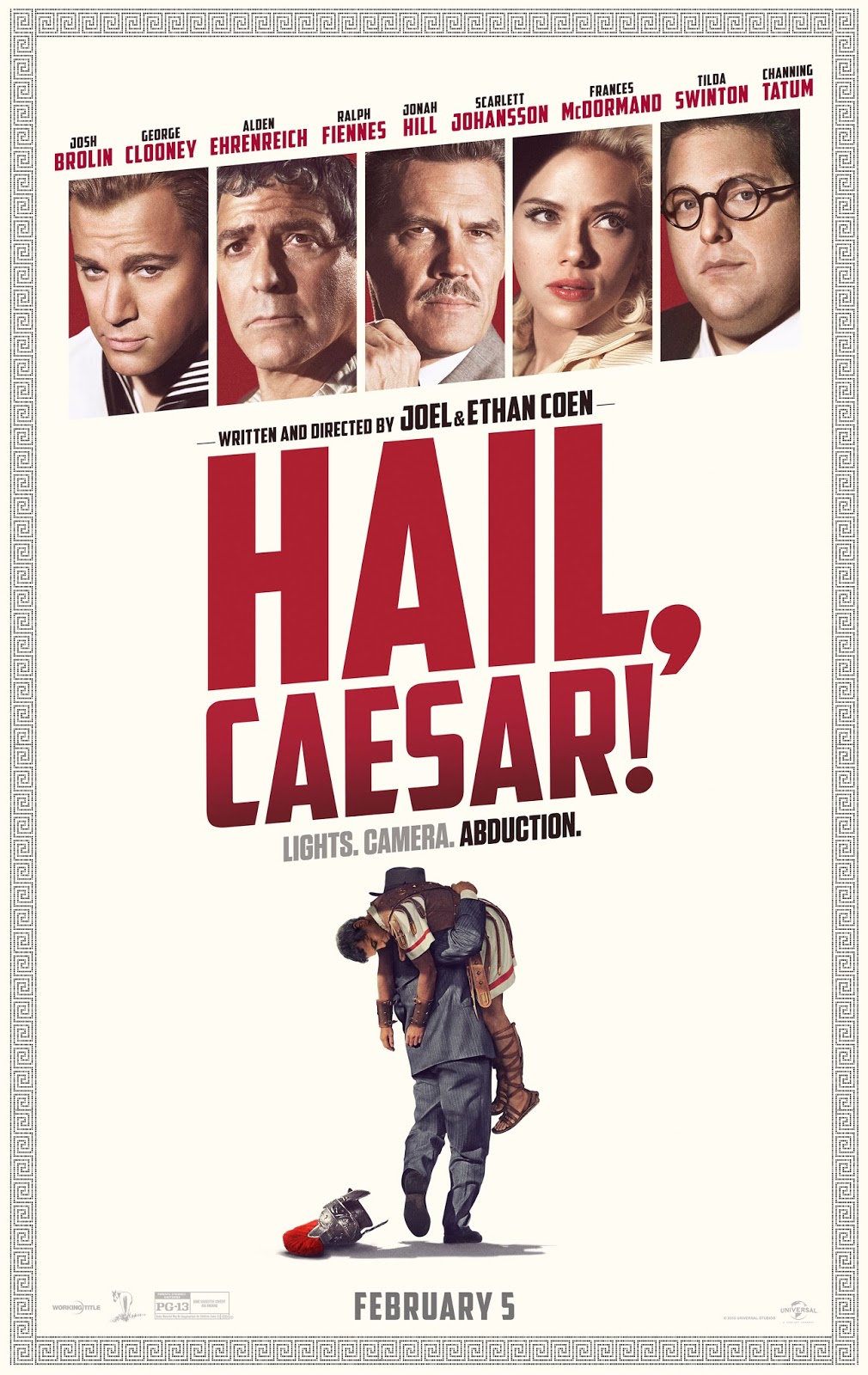
        There are supposedly two distinct types of Coen Brothers movies: the serious ones, and the fun ones. More so than any modern directors not named Steven Spielberg, Joel and Ethan's filmography alternates between the silly and the straight-faced at an almost perfect 1:1 ratio. Their dour noir debut, 1984's Blood Simple, was immediately followed with the wacky mania of Raising Arizona, just as Cannes film festival sensation Barton Fink made way for The Hudsucker Proxy's manic screwball energy, Oscar-winner Fargo begat legendary stoner comedy The Big Lebowski, and their most widely celebrated work to date, No Country For Old Men, served as a precursor to the laughter-inducing lark Burn After Reading. But where Spielberg refuses to allow intellect to spoil the fun of something like Jurassic Park, and finds little time or space for lightness of touch in either Lincoln or Saving Private Ryan, the Coens have always proven eager to let their paints mix. Humor and rumination are immovable mainstays of their every work, and while one is usually prioritized over the other, you don't have to squint to observe them working in concert with one another. As a matter of fact, you could just go buy a ticket to Hail, Caesar!

        A multi-layered foray into Hollywood of the 1950's, Hail, Caesar! portrays a hurried, harried 36 hours in the life of Eddie Mannox (Josh Brolin), a tinseltown 'fixer' employed by Capitol Pictures. Though his job takes him to the sets of snobby period pieces, aquatic pageants, and flamboyant musicals, Mannix's main concern is a swords-and-sandals epic from which the Coens' film takes its name, a tale of the Christ as witnessed from the prospective of a Roman soldier. The lavishly-budgeted production is thrown into chaos when its silver-screen superstar Baird Whitlock (George Clooney) is kidnapped from the set, a ransom note demanding a tidy $10,000 left in his wake. Mannox goes about locating his captor, all while being summoned in innumerable directions to put out the myriad of fires that the studio's various departments continuously ignite with fervor and reckless abandon.

        Ludicrous occurrences and genre-hopping relish aside, there's something about the both the tone and pacing of Hail, Caeser! that immediately butts heads with the zippy, zany flick that its trailers seemed to promise. Unplanned pregnancy and domestic violence are both on the table in the film's early goings, not to mention a roundtable discussion featuring higher-ups from diverging Abrahamic faiths debating the ethics and accuracies of portraying Jesus on celluloid. There are too many spinning plates on hand to properly explore any of these notions, but the film at large isn't in a rush to get away from them either, relaying its story in a steady, mid-tempo time signature. Where the likes of Aaron Sorkin and Martin Scorsese (not to mention the Coens themselves) have fitted their walk-and-talk dramas and comedies with a break-neck speed, Caesar brings the RPMs way down, the flapping lips and moving feet progressing in pseudo-slow-motion. Much of the comedy is welcomely broad, but the proceedings always feel more earnest than urgent, collectively toying with some knotty ideas that only come into focus near the film's conclusion.

        Don't mistake this as a claim that Joel and Ethan are asleep at the wheel during the interim; the brothers may be driving at a cost-effective speed, but when it comes to the places they visit, no expenses are spared. Each of the aforementioned movies-within-the-movie is dazzlingly realized, exquisitely mounted, and deeply-steeped in affection for 'the old ways' of doing things, to the point where brazen satire and heartfelt homage somehow merge into one another. Production Designer Jess Gonchor, along with Set Decorator Nancy Haigh and Art Directors Cara Brower  and Dawn Swiderski, deserves endless praise for locating such a specific brand of lived-in artifice, while Mary Zophers may well be the front-runner for next year's Best Costume Design Oscar. The whole venture is immaculately tactile, a veritable cinematic playground featuring a slew of today's most respected actors behaving as if the bell just rang, and recess has finally begun.

        Metro-Goldwyn-Mayer, the film studio from which the fictitious Capitol Pictures gains its inspiration, famously claimed to have "more stars than there are in heaven," a boast which the Coens seem determined to back up with their most famous cast to date. Brolin is captivating and surprisingly intense, and Clooney's wide-smiling imbecile proves perfectly in line with his previous Coen collaborations, but it's the rest of the cast that really pops. Scarlett Johansson, Jonah Hill, and Frances McDormand are each outstanding in their miniature roles, while Ralph Fiennes and Tilda Swinton ascend to the level of note-perfect with similarly bite-sized amounts of screen time. Relative unknown Alden Ehrenreich somehow manages to stand out amidst this bevy of Oscar nominees with a performance that would be both the film's funniest and most charming... if Channing Tatum wasn't here. His lone musical number is delightful enough to make time stand still, not to mention the unpredictable turn his character takes in the film's final act. For prolonged stretches, it feels like half of Hollywood is here to serve that great, glittering ideal that is entertainment.

        Their offerings combine to clarify the film's thesis without distracting from its meat-and-potatoes entertainment value, operating in tandem with rampant musings on religion, politics, media, and that blank space in the heart of man that the Coens have made a career out of exploring. Hail, Caesar! is a film about faith, and about service in the name of faith, a nebulous proposal that's always floating around the movie's margins, before you have a clue that it's even there. Each of its characters is dying at the alter of something, whether it be journalism, war, economic ideologies, public perception, or any of the aforementioned causes. They're all fighting for something they believe in, even if, as is frequently the case, they have only a fleeting grasp on what exactly that is. Staring down into that infinite black hole that is purpose has always been at the forefront of the Coens' movies, each with a slightly different shade than the next. Hail, Caesar! is no different, and while ignoring its theological wrestlings in favor of its off-kilter joke telling is entirely possible, I for one take umbrage with the 'minor Coens' tag with which it's been saddled. The film is gorgeous, funny, and stuffed to the brim with serotonin-triggering performances. It just so happens that when you're the Coens, even a rollicking comedy is worthy of deep, soul-searching analysis.

Grade: A
     

Wednesday, February 10, 2016

HypeCast: Hail Casear!, Legend, and Son of Saul

        Hello, and welcome back to the HypeCast, a film-centric podcast hosted by Collin Sherwood Elwyn and Tyler Mitchell. In today's episode, Collin and Tyler discuss Hail, Caesar!, the latest from the Coen Brothers, and the first big release of 2016. A love/break-up letter to Hollywood of the 1950's, the film features a bevy of prestigious thespians behaving like imbeciles as they attempt to find meaning in our collective pointless existence. In other words, it's a Coen Brother's movie! Next on the docket is Legend, a gangster flick starring Tom Hardy and... Tom Hardy, because the more ridiculous accents you can fit into one movie, the better. The film coaxes Tyler into employing his most frequently-used, mono-syllabic movie review ('meh'), an obliging analysis that Collin can't quite muster up for Son of Saul, the latest entry into last year's seemingly endless depictions of utmost misery... and, fittingly, the front runner to win Best Foreign Feature at the Oscars. Elwyn also sorrowfully relays a terrible tale of a former co-worker's preferred version of The Pixies' Where is My Mind? Warning: occasional naughty words are contained within. Continue at your own risk. Here We Go!


Podcast Itinerary:
0:00-47:34---Hail, Caesar!
47:35-59:04---Legend
59:05-59:06---Son of Saul

Sunday, February 7, 2016

HypeCast: Love & Mercy, Shaun the Sheep, and... A Pigeon Sat on a Branch Reflecting on Existence

        Hello, and welcome back to the HypeCast, a film-centric podcast hosted by Collin Sherwood Elwyn and Tyler Mitchell. In today's episode, Collin and Tyler discuss a trio of under-seen 2015 wonders from all over the globe, each hailing from an incredibly different genre. First up is Love & Mercy, the Brian Wilson biopic about which Collin can hardly contain his enthusiasm. Who knew that a music movie could actually be about music, and the process of its creation? Speaking of music, that's all you'll hear in Shaun the Sheep, Aardman Studio's latest stop-motion animated adventure that Tyler neglected to inform Collin was a silent film. Finally, clear your throat, because here comes A Pigeon Sat on a Branch Reflecting on Existence, a brazenly esoteric Swedish film that Elwyn ends up adoring, and whose title Mitchell can hardly endure. Warning: occasional naughty words are contained within. Continue at your own risk. Here We Go!


Podcast Itinerary:
0:00-25:17---Love & Mercy
25:18-37:58---Shaun the Sheep
37:59-53:38---A Pigeon Sat on A Branch Reflecting on Existence
53:39-58:56---The Producer's Guild Awards

Friday, February 5, 2016

HypeCast: Carol, Mistress America, and Joy


        Hello, and welcome back to the HypeCast, a film-centric podcast hosted by Collin Sherwood Elwyn and Tyler Mitchell. It's Ladies Night, so in today's episode, Collin and Tyler discuss a three-pack of female-driven releases from the year 2015. First up is Carol, the yesteryear-set lesbian romance from (Portland's own!) director Todd Haynes. Then we're on to Mistress America, a film that Tyler likes well enough, and forces Collin to decide if he's more in love with Greta Gerwig, or hipster cliches. Finally, we arrive at Joy, the latest David O. Russell and Jennifer Lawrence collaboration, wherein together, they brave the unknown, and create the Miracle Mop. Warning: a few naughty words are contained within. Continue at your own risk. Here We Go!